

In the digital era, the recruitment process has evolved far beyond simply reading CVs and conducting interviews. Companies now must move quickly, screen candidates with precision, and ensure long-term compatibility—not just a match on paper.
The question is:
Can AI replace the role of human recruiters?
Or should the two work hand in hand?
At Dikshatek Indonesia, we see AI not as a replacement, but as an accelerator for recruitment teams. The combination of artificial intelligence and human judgment delivers far more effective results than either one alone.
Let’s break it down.
The Strength of AI in Recruitment
AI brings three major advantages to the modern hiring process:

1. Fast, Data-Driven Analysis
With our internal platform, AI analyzes thousands of profiles in a short time, matching candidate skills with specific project or company needs.
This reduces reliance on subjective judgment and speeds up the initial screening process.
Benefits:
- Faster time-to-hire
- More precise shortlists
- Reduced human error in early selection
2. Automatic Ranking & Matching
Our matching engine prioritizes candidates based on probability of success, considering:
- Performance history
- Work preferences
- Relevant skills
The result? Clients receive a high-quality shortlist without going through exhausting manual processes.
3. Operational Efficiency
AI automates administrative tasks such as:
- Filtering duplicate CVs
- Hiring reports and documentation
- Recruitment activity tracking
Recruitment teams are no longer buried in admin work and can focus on strategic interactions.
Human Recruiters’ Irreplaceable Role

While AI excels in speed and analytics, human recruiters remain essential—especially in areas requiring intuition and emotional understanding.
1. Identifying Cultural Fit
AI can assess skill alignment, but determining whether someone is culturally compatible requires understanding interpersonal nuances—something uniquely human.
2. Building Trust and Relationships
Top candidates often choose a workplace not just for salary, but for connection with the team, company vision, and feeling valued. These relationships cannot be built by algorithms.
3. Assessing Context & Unique Situations
Not all “perfect on paper” candidates are the best in practice. Experienced recruiters understand business context, team dynamics, and long-term needs.

AI vs. Humans: Not a Competition, But a Collaboration
Instead of replacing humans, AI strengthens recruiters so they can work more strategically.
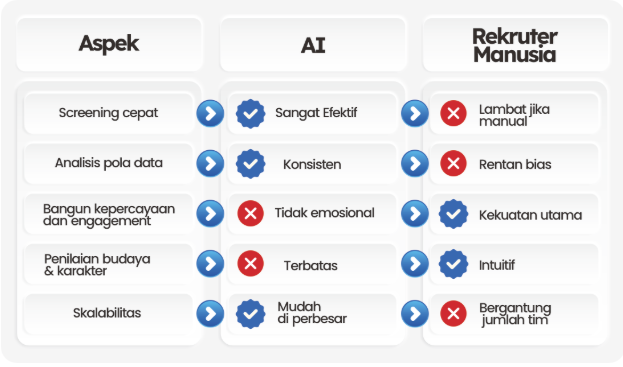
Conclusion: AI boosts efficiency, humans ensure quality.
How Dikshatek Combines Both
Dikshatek leverages a hybrid approach:
AI for Recruitment Efficiency
- Automatic matching
- Machine learning–based pre-screening
- Predictive candidate success modeling
Human Recruiters for Strategic Judgment
- Final interviews and cultural assessment
- Negotiation and personal communication
- Client needs consultation
With this approach, clients get:
- Faster processes
- More accurate candidates
- Stronger professional relationships
Conclusion
Modern recruitment isn’t just about choosing the fastest candidate—it’s about finding the right one.
AI accelerates and strengthens the process.
Human recruiters ensure the right decisions are made.
At Dikshatek Indonesia, the two don’t replace each other—they work together to deliver the best results.